A single-arm medical pendant is generally suitable for operating rooms that need a compact, clearly defined equipment service area, while a double-arm medical pendant offers a wider positioning range and greater flexibility for rooms with more complex equipment layouts. Neither design is universally better. The right choice depends on the clinical workflow, ceiling structure, equipment load, required reach, and room dimensions. For hospitals planning a medical ceiling pendant installation, understanding these differences is essential to selecting a safe and practical configuration.
This guide compares single-arm and double-arm medical pendants from the perspectives of mechanical structure, operating room applications, equipment arrangement, installation requirements, and hospital procurement.
What Is a Single-Arm Medical Pendant?
A single-arm medical pendant is a ceiling-mounted medical supply unit supported by one articulated arm connected to a vertical service column. The arm allows the column to rotate and move within its designed operating range, bringing medical gas outlets, electrical sockets, equipment shelves, and other utility connections closer to the clinical team.
In an operating room, a single-arm configuration is often used to support a specific workstation, such as an anesthesia area or a designated equipment zone. Its relatively straightforward structure can make equipment positioning easier to plan when the room has a clear layout and moderate utility requirements.
Depending on the model and project specification, a single-arm pendant may include:
- Medical gas outlets for the gases required by the clinical department.
- Electrical sockets for anesthesia machines, monitors, and other medical devices.
- Equipment shelves, drawers, and accessory mounting rails.
- Cable management features to help organize power and signal connections.
- A rotating arm and braking system for controlled positioning.
The main advantage is not simply that the unit has fewer components. It is that the service column can be positioned within a defined working area without requiring the wider reach of a two-arm arrangement. For rooms with predictable equipment placement, this may be an efficient solution.
What Is a Double-Arm Medical Pendant?
A double-arm medical pendant uses two connected articulated arms between the ceiling mounting point and the service column. The additional arm joint provides another positioning point, allowing the column to move through a broader range of positions, subject to the equipment's mechanical design and installation limits.
This configuration can be useful in operating rooms where equipment needs to be moved between different working positions. For example, the anesthesia team may need access to equipment near the head of the operating table, while the clinical team also needs to maintain clear access around the surgical field.
Typical configuration options may include:
- Two articulated support arms with defined rotation ranges.
- A vertical service column with medical gas and electrical interfaces.
- Equipment shelves and mounting rails for medical devices.
- Integrated cable routing and mechanical or electromagnetic braking systems.
- Optional accessories according to the intended clinical application.
The additional arm can increase positioning flexibility, but it also introduces more mechanical joints and a larger movement envelope. Hospital planners should therefore assess the full movement path, ceiling clearance, neighboring equipment, and the intended equipment load before selecting a double-arm system.
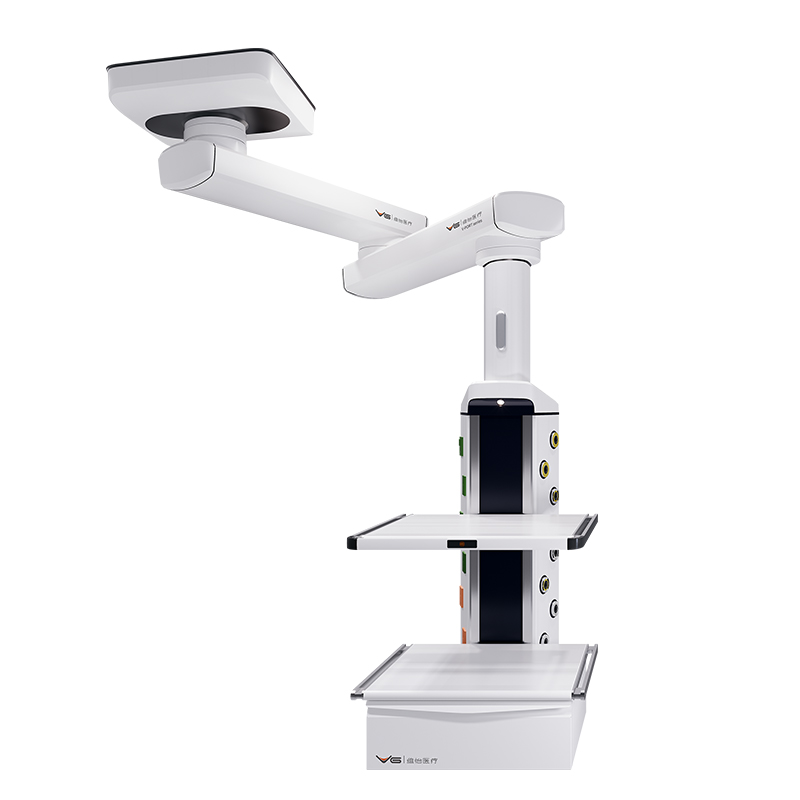
VG Medical V-PORT C Series – articulated medical pendant configuration
Single-Arm vs. Double-Arm Medical Pendants: Key Differences
The primary difference is the number of articulated support arms and the positioning options they provide. However, the number of arms alone does not determine load capacity, safety, or suitability. These specifications must be checked against the manufacturer's technical documentation for each model.
| Comparison | Single-Arm Pendant | Double-Arm Pendant |
|---|---|---|
| Arm structure | One articulated support arm | Two connected articulated arms |
| Positioning range | Suitable for a defined service area | Can provide a wider range of positioning options |
| Movement flexibility | Relatively straightforward movement path | More positioning flexibility through an additional joint |
| Mechanical structure | Fewer articulated joints | More articulated components and joints |
| Room planning | Works well with a clearly defined equipment zone | Requires assessment of a larger movement envelope |
| Typical consideration | Compact layout and focused equipment access | Flexible positioning and changing equipment locations |
One important procurement point: a double-arm design does not automatically have a higher safe working load than a single-arm model. The permissible load depends on the arm structure, joint design, column configuration, mounting system, and the manufacturer's rated specifications. Buyers should compare rated loads and load distribution rather than assuming that more arms mean greater capacity.
Which Medical Pendant Is Better for an Operating Room?
The better choice depends on how the operating room is used. A pendant should be selected according to the equipment it supports and the working positions required by the clinical team, not simply according to its arm configuration.
When a Single-Arm Pendant May Be Suitable
A single-arm medical pendant may be appropriate when:
- The room has a relatively compact or straightforward equipment layout.
- The pendant mainly serves one defined workstation.
- The required equipment can remain within a predictable working area.
- The hospital wants to avoid unnecessary mechanical reach where it is not needed.
For example, an anesthesia workstation may be planned around a fixed area near the patient's head. If the required medical gases, electrical connections, shelves, and devices can all be reached through the specified arm movement, a single-arm configuration may be sufficient.
When a Double-Arm Pendant May Be Preferable
A double-arm medical pendant may be worth considering when:
- The service column needs to move between multiple working positions.
- The room layout requires greater flexibility around the operating table.
- The clinical team needs to reposition supported equipment during different stages of a procedure.
- The equipment arrangement requires a longer or more adaptable reach, within the model's rated operating range.
For a complex operating room, the additional arm may help the team reposition the service column while maintaining access to medical utilities. However, the final layout should be checked against surgical lights, imaging equipment, ceiling-mounted displays, and other suspended devices to prevent movement conflicts.
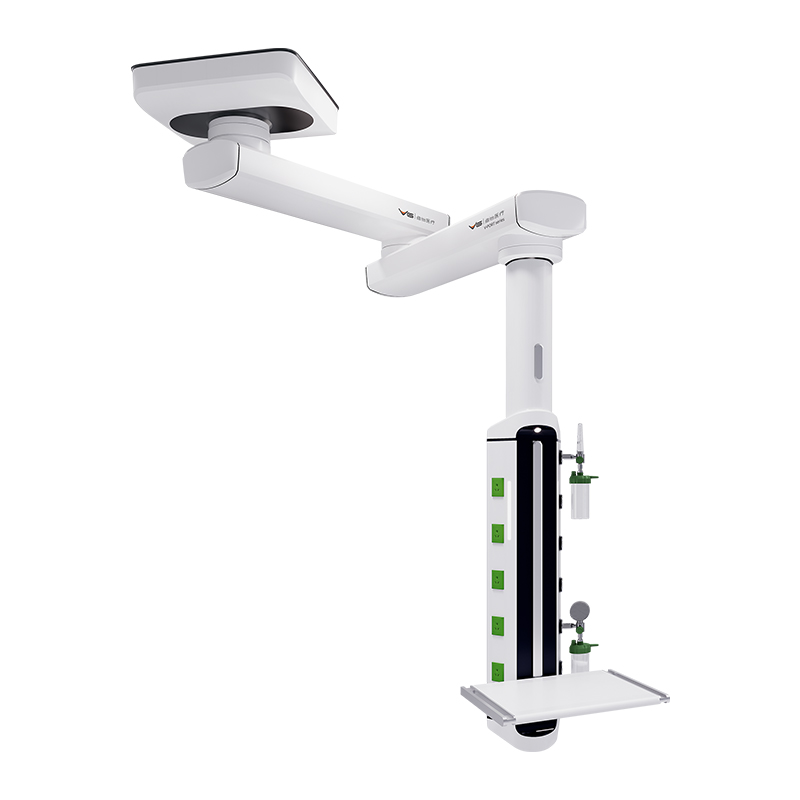
V-PORT C Series medical pendant – service column and utility arrangement
Five Factors to Consider Before Purchasing a Medical Ceiling Pendant
For hospital procurement teams, distributors, and operating room contractors, the following factors are more useful than comparing arm numbers alone.
1. Equipment Load and Load Distribution
List every device planned for the pendant, including anesthesia machines, patient monitors, infusion equipment, shelves, and accessories. Confirm the rated load for each shelf, column, arm, and complete assembly. Also check whether the manufacturer's load rating changes with arm extension or equipment position.
2. Arm Reach and Rotation Range
Ask for the technical drawings showing the arm length, horizontal reach, rotation angles, and permitted movement area. A double-arm system may offer more positioning options, but its movement envelope must not interfere with surgical lights, ceiling tracks, monitors, or staff access routes.
3. Medical Gas and Electrical Configuration
The number and type of gas outlets and electrical sockets should match the room's clinical requirements and local regulations. Confirm gas type, outlet standards, electrical ratings, socket types, and the required separation of services before finalizing the configuration.
4. Ceiling Structure and Installation Conditions
The ceiling support structure must be suitable for the pendant's total installed load and dynamic forces during movement. Project teams should verify the mounting method, structural reinforcement, ceiling height, service access, and coordination with medical gas and electrical contractors. Installation should follow the manufacturer's instructions and applicable local standards.
5. Cleaning, Maintenance, and Future Expansion
Smooth surfaces, accessible components, organized cable routing, and reliable braking systems are important for long-term use. Hospitals should also ask about inspection intervals, spare parts, maintenance access, and whether the configuration can accommodate future equipment changes.
Medical Pendant Solutions from VG Medical
VG Medical Technology has specialized in operating room and ICU equipment manufacturing since 2003. Its product portfolio includes surgical lights, operating tables, medical pendant systems, and digital integrated operating room solutions. The company's ceiling supply unit range includes the V-PORT C SERIES and V-PORT B SERIES, designed for different clinical and space-planning requirements.
The V-PORT C SERIES is presented as a modular medical supply unit for operating rooms and intensive care settings. Its published product features include standard equipment rails, equipment-support capability, oxygen leakage alarm options, in-chamber cable management, electromagnetic braking, and multiple column configurations. The product page also identifies compliance with IEC 60601-1, IEC 60601-1-2, RoHS, and NFPA 99. Buyers should confirm the applicable standards and certifications for the exact model and target market before purchase.
The V-PORT B SERIES is a bridge-type medical supply unit. It should be evaluated as a bridge configuration rather than treated as simply another name for a double-arm pendant. Its design can support a different approach to distributing medical utilities and equipment across a clinical area.
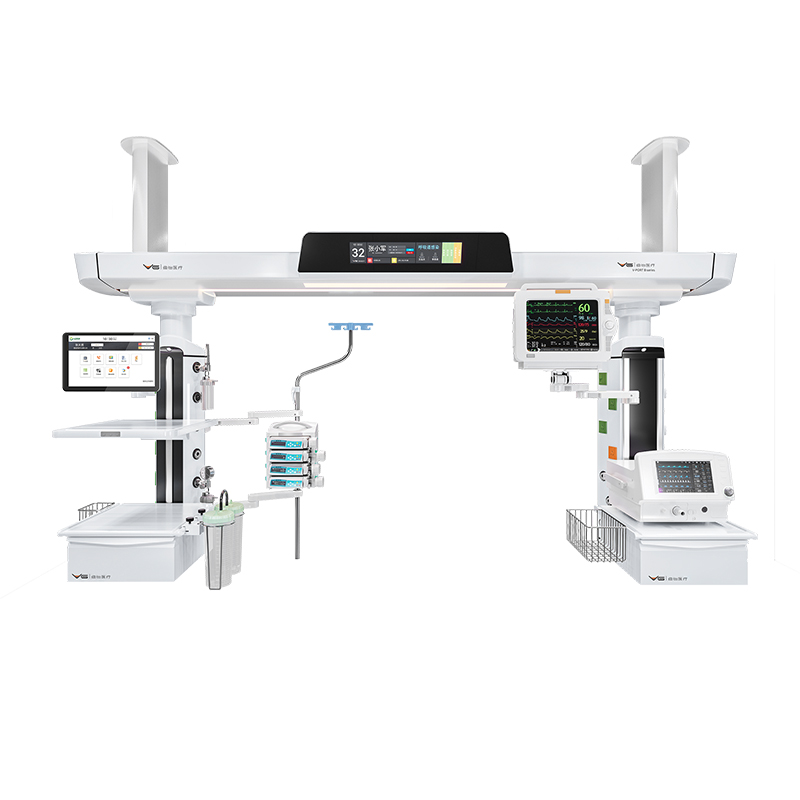
VG Medical V-PORT B SERIES – bridge-type medical supply unit
For hospitals and medical equipment distributors, VG Medical can be considered as a manufacturing partner for operating room and ICU equipment projects. The appropriate pendant configuration should be determined through project-specific review of room drawings, equipment lists, utility requirements, and installation conditions.
Explore the medical pendant range or review the VG Medical solutions for operating rooms and intensive care environments.
Frequently Asked Questions
Q1. What is the main difference between a single-arm and double-arm medical pendant?
The main difference is the articulated support structure. A single-arm pendant uses one arm between the ceiling mount and service column, while a double-arm pendant uses two connected arms. The additional joint can provide more positioning flexibility and a wider movement range, depending on the model design.
Q2. Is a double-arm medical pendant always better than a single-arm pendant?
No. A double-arm pendant may be preferable when the service column needs a wider positioning range. A single-arm model may be sufficient for a clearly defined workstation. The decision should be based on clinical workflow, room dimensions, equipment load, and the manufacturer's technical specifications.
Q3. Does a double-arm pendant have a higher load capacity?
Not necessarily. Load capacity depends on the structural design, mounting system, arm dimensions, joints, and rated specifications of the specific model. Hospitals should request the manufacturer's load data for the complete assembly and each equipment-support component.
Q4. Can a medical ceiling pendant be used for both anesthesia and surgical applications?
Medical ceiling pendants can be configured for different clinical workstations, but the required outlets, shelves, equipment supports, and accessories may differ. Anesthesia and surgical pendant configurations should be planned according to the devices and utility connections required in each zone.
Q5. What information should a hospital provide when requesting a medical pendant quotation?
A useful quotation request should include the room layout or ceiling plan, intended clinical application, equipment list and estimated loads, required medical gas outlets, electrical requirements, preferred arm configuration, ceiling height, and target-market standards. This information helps the manufacturer recommend a suitable configuration.
Q6. What is the difference between a double-arm pendant and a bridge-type medical pendant?
A double-arm pendant uses two articulated arms to support a movable service column. A bridge-type medical pendant uses a larger overhead bridge structure to distribute equipment support and utilities across a wider area. They are different structural designs and should be evaluated according to room layout and clinical requirements.
Request a Medical Pendant Configuration for Your Project
Choosing between a single-arm and double-arm medical pendant requires more than comparing product appearance. The right configuration should provide the required working reach, support the planned equipment load, match the medical gas and electrical requirements, and fit the operating room's ceiling and workflow design.
If you are planning a new operating room, upgrading an existing clinical space, or sourcing medical ceiling pendants for distribution, contact VG Medical to discuss your project requirements and product configuration.
Website: VG Medical Technology